
Henry Gamroth and the men of Hacksaw Ridge
Anyone who saw the movie “Saving Private Ryan” or the docuseries “Band of Brothers” came away with a good understanding of what the combat of war puts men through.
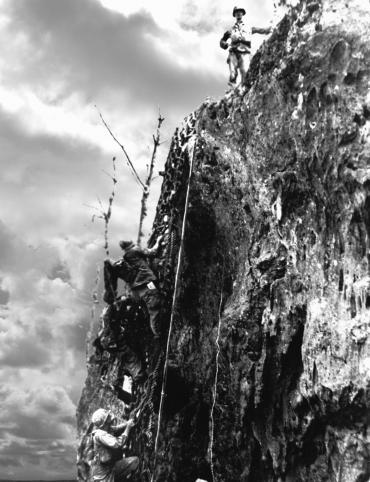
The 2016 Mel Gibson directed film “Hacksaw Ridge” showed what the war in the Pacific was like. Focusing on a specific event during the Battle of Okinawa, it highlights the actions of Corporal Desmond Doss, 7th Day Adventist and conscientious objector who refused to carry a weapon but, yet, served as medic for Company B, 307th Infantry Regiment, 77th Infantry Division. In early May1945 he lived Hacksaw Ridge, or the Battle for the Maeda Escarpment, as it is known to historians and others.
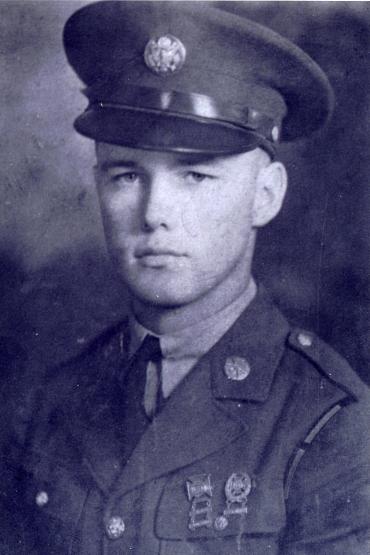
Sergeant Henry Gamroth of Independence also lived Hacksaw Ridge as a squad leader (10 men) of Company B, 307th Infantry.
Hank enlisted in the U. S. Army in February 1939 and originally joined the 89th Infantry Regiment. But upon learning that paratroopers were paid $50 more a month, he began training with the 503d Paratroop Infantry Regiment. On his third tower training jump, however, he injured his back and ankle, thus ending his paratroop experiment.
He next was assigned to Company B of the 307th Infantry, went to Hawaii for jungle training, and then landed with the 77th Infantry Division during the invasion of Guam, where he experienced his first taste of combat. There, he participated in the fierce battle to take the village of Barrigada.
Following the securing of Guam, the division next landed on the west coast of Leyte in the Philippines on Nov. 23, 1944. After taking the town of Ormoc, the 77th’s commanding general issued the statement to 6th Army’s commander, “Have rolled two sevens in Ormoc.” The 307th then fought its way north where it ultimately liberated 15,000 Filipino prisoners.
Though he had already been in heavy combat, it was the Ryukyus Islands campaign, however, that defined Hank Gamroth. First, the 307th landed on the Kerama Retto group of islands southwest of Okinawa, where it discovered more than 500 Japanese suicide boats. Then it invaded Ie Shima to the northwest where famed war correspondent and buddy of the 77th was killed.
The division next landed on Okinawa itself late in April and soon relieved an exhausted 96th Infantry Division. The 96th had begun its assault of the Maeda Escarpment, a rocky outcrop that topped out at 500 feet, on April 26, but could not take it – it was that well defended. Men of the 96th would be pushed off by the Japanese, with many sobbing and saying they wouldn’t go back – it was that brutal – and, yet, they did.
On April 30, the 307th was in position to launch its attempt to take the escarpment. The men of Company B were ordered to climb a 30- to 70-foot cliff. It couldn’t be done and many casualties were suffered. On May 2 a grenade landed next to Hank; when it exploded it killed the two men with him but left him unscathed. That night cargo nets and ropes were brought up and the following day, Company B and others led another assault. The Japanese were laying down murderous mortar fire and grenades. While on a net, a mortar shell exploded near Hank, knocking him to the ground below. With a seriously injured leg, he lay there expecting the worst because he could hear Japanese voices coming from a nearby cave.
After a while, however, a medic appeared, treated him and carried him to safety. It was Company B’s medic, Corporal Desmond Doss.
Hank was transferred to a hospital ship and taken to a hospital on the Marianas Islands. The wound was severe enough for him to then be sent back to the States. But he was a lucky one, one of only two in the 10-man squad he led to survive that attack.
Desmond Doss was later awarded the Congressional Medal of Honor, credited with saving the lives of 75 soldiers, including Hank Gamroth, before he himself had to be evacuated due to four wounds.
In 1987, while reading an article about Doss, Hank realized this was the man who had saved his life. Hank was able to contact him in Georgia, and though Doss was completely deaf, through his wife was able to thank him for what he had done to save him. This story appeared in major newspapers across the country. Of Doss, Hank said, “I can’t figure that guy out. The lead was flying. He was bending over and treating the wounded.”
About the greatest battle of the Pacific war, Hank later said, “From Ie Shima . . . we were ordered to relieve the 96th Division on Okinawa. Until then, we soldiers thought that the battles we had fought were like hell. Okinawa, to our surprise, was like many ‘hells’ put together. My Company went on line with full strength at 11 a.m., but very few of us remained alive by nightfall.”
Henry was awarded the Purple Heart and Bronze Star for the leadership of his squad at the Maeda Escarpment. He went on to serve as police chief in Independence for 26 years.
And all he and the men of the Maeda Escarpment did was help save the world.
Mike Lyga is the author of “A Small Town Goes to War: Histories of World War II Veterans of Independence, Wisconsin” and founder of the Independence Veterans Memorial Museum at the Independence Public Schools. He can be contacted at: lyga@new.rr.com The author urges readers to look up and read Doss’s Medal of Honor Citation.
