
Independence teacher hopes to help break cultural barriers
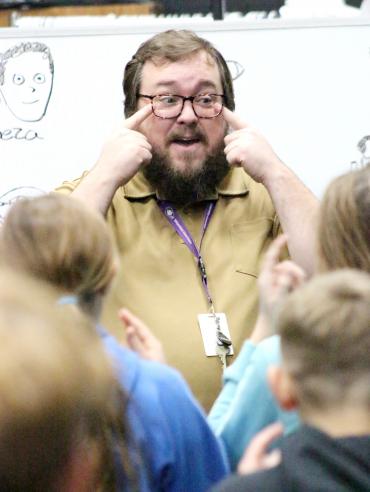
High school Spanish/English teacher Ryan Jennings taught a group of Independence Elementary School students on Dec. 7 about Spanish through a game of ‘Profe Says'. Jennings spends his prep periods teaching younger students about outside cultures through language and exercises. (Times photograph by Benjamin Pierce)
Shortly after Ryan Jennings graduated high school, he made a substantial change.
Jennings lived for five years — or as he recalls, grew into an adult — in Mexico City after moving to Mexico’s capital immediately after high school.
Jennings was equipped with two years of high school Spanish and assumed he would be able to communicate sufficiently in his new home. He was hit with a “rude awakening” that Spanish was still a foreign language and culture.
He struggled with an adjustment period and the immersion process of pointing at objects, admitting he initially made noises and acted toddler-esque as he learned how to speak and assimilated into a new country.
“I was just an 18-year-old kid, and when I came back five years later I was a man. I left a lot of my best friends there and fell in love with the culture, and that’s how I learned Spanish. … through that struggle I gained an appreciation for the language, an appreciation for the culture, for all my friends and those I now consider family,” Jennings said.
That same appreciation for Hispanic culture brought Jennings to the Independence School District, where he currently teaches Spanish and English to middle and high school students in a district that is 50.7% Hispanic or Latino, according to its 2022-23 Department of Public Instruction enrollment data.
Jennings decided to go back to college as a nontraditional student to earn his degree in Spanish education. He is in his first year at Independence, where he sometimes spends his prep periods teaching elementary students Spanish, kids he otherwise wouldn’t teach.
He spent Dec. 7 behind the curtains of the auditorium at Independence High School educating young students on Spanish culture.
As Jennings instructed the kids through a game of ‘Profe Says’ in which they learned the names of different body parts, one Spanish-speaking first-grader smiled and shouted an answer as he recognized one of the words. An English-speaking fifth-grade boy who said they didn’t speak the language ended up winning their game of ‘Profe Says’.
Jennings often turns to music and fun learning such as games with young students, and the first year teacher said he tries to find ways for Spanish-speaking students to feel like they belong while also furthering education for all kids.
“The reason I’m doing this really is I’ve found that it helps both Spanish speakers and non-Spanish speakers make connections together. It bridges that gap that they have in language because it provides the non-Spanish speakers with similar language they can use with their Spanish speaking classmates but also allows the Spanish speaking students to feel represented, which is super important,” Jennings said.
Whenever Jennings passes the younger students in the school, they are quick to shout ‘Hola!’ to the teacher they now know as ‘Profe’.
“They crave opportunities to speak Spanish,” Jennings said, “which is a good sign that in future classes they will be able to make more connections with Spanish speakers and have a shared culture.”
Jennings: Cultural exposure can help students outside foreign language
Jennings gives up one prep period every other week to spend time with the younger kids. Jennings has his degree in Spanish Education and also teaches English. He teaches a class called Spanish Language Arts for students who don’t speak sufficient academic English and instead earn credits in language arts through Spanish language and literature.
District Administrator Paul Franzwa said Jennings’ want to impact more students is a welcomed trait.
The district used to offer an elementary Spanish class but has not in recent years due to staffing, Franzwa said.
“As a nontraditional teacher, as a first-year teacher, it’s important that he has time to prepare, reset and catch his breath,” Franzwa said of Jennings, “but we also want to support people in things they are passionate about, especially when they benefit our students. It says a lot about him being here for the right reasons, and he has such a strong student-centered approach to education.”
When Jennings started at Independence he saw that students in the district were inclusive, but students tended to self-segregate, he noticed. Sometimes in the lunch room he saw the Puerto Rican students together while the Mexico-native students sat elsewhere and the Wisconsin born-and-raised kids were in another area.
“What I wanted to kind of combat was the self-segregating mentality among cultures, and I figure the only way to combat that is to start early. If we’re able to create a common cultural language they can share from a young age, they can make more connections. And the more connections they make, the more friendships they can hold onto.”
The exposure Jennings gives students helps them understand each other, Franzwa believes.
“From the pure form of just being able to communicate with each other and exposing them to some cultural traditions and how things are different — and then through the language, too — it helps understanding each other and exposing students to diversity. We’re fortunate our students have these opportunities,” the administrator said.
Jennings referenced an idea of code-switching in the brain, a scientific term which refers to the way a bilingual student’s brain switches back and forth between languages and processes new information.
“I think one thing most people don’t understand is that the benefits of being bilingual aren’t just social benefits. A lot of people point out, ‘If you’re bilingual you can get a job, you can put it on your college applications, you can get into good colleges.’ Those are benefits for sure, however there is also an intellectual and mental benefit to being bilingual as well that speaking two languages trains your brain to increase your ability to think faster,” Jennings said.
He believes cultural and foreign language education should be a priority in schools.
“The English, math, science, sometimes history, those are usually considered the big, essential classes, right? But my thought is being bilingual can help you in every single one of those classes, so sometimes I feel like learning a second language should be just as important because it benefits you in so many other aspects of your life.”
