
Students: Inaugural summer counseling program at G-E-T High “really helped”
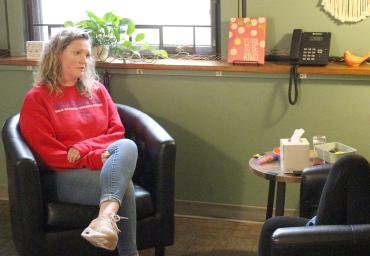
Counselor Maddie Vinzant sat down with a student in her office at Gale-Ettrick-Trempealeau High School in October for a check-in. Vinzant led the school’s first ever summer counseling program this year to help students combat mental health concerns and stay connected during the summer months when kids are typically away from school. (Times photograph by Benjamin Pierce)
Gale-Ettrick-Trempealeau High School counselor Maddie Vinzant has long grappled with the fact that some of her students spend the summer months without support due to no fault of their own.
Vinzant took action last summer, launching the school’s first summer counseling program to stay connected and give students an outlet.
Eleven kids participated in the program, which zeroed in on two key focuses —social/emotional support and combatting ‘summer melt’ for 2023 graduates.
This year’s program was offered as a summer school class.
“I want to make sure that every single kid in our school has access to free support year-round, not just during the academic year,” she said. “Mental health issues, family concerns or whatever it is, those things don’t go away in June, July and August, so it’s making sure that students have support regardless of the time of year.”
Fighting summer melt
Vinzant also hoped to fight the concept of ‘summer melt’ — which is more common in students of lower socioeconomic status, first generation students and students of color — where students are accepted to college in May but never make it onto campus in the fall.
“They need support along the way. Helping those kiddos who may not have access to information on how to navigate the system of higher education, so knowing that we can help and aid in that was the other piece I was trying to offer,” Vinzant said.
Some students met with Vinzant weekly, and others checked in periodically. Conversations were had in person, virtually and occasionally as a group in a public setting.
When Aidrian Miralles graduated from G-E-T last spring, she was upset that she would no longer be able to sit down with Vinzant.
“As a person that grew up in a family that wasn’t the greatest, having someone that I could actually talk to that wasn’t sitting there judging me, giving a lecture you get from a therapist, Mrs. Vinzant was more like a best friend you could confide in.”
When Vinzant reached out to tell Miralles that she could participate in summer counseling, the current University of Wisconsin-La Crosse student didn’t hesitate to sign up.
“Counseling isn’t just a school year thing. It is something that is needed year-round, and some kids just can’t afford an outside therapist. So having someone like Mrs. Vinzant—someone you know you would be talking to not just for that day but continue when you enter school—was a really amazing thing.”
Miralles and Vinzant talked through social/emotional support, mental health and planning for post-graduation.
Miralles is attending UW-La Crosse full-time and plans to major in sociology. She aspires to be a behavioral therapist.
“I always wanted to work with people, and originally it was going to be the younger audience … I fell for sociology and realized I could be working with so many more people … Mrs. Vinzant played a pivotal role in that. Just the way she has helped me so much and how that help can be reciprocated one person at a time.”
Students: Mental health support should grow
Current students at G-E-T also participated in summer counseling.
Katie, a student who asked that her real name not be used, told the Times that she and Vinzant talked through mental health, body positivity and planning for the future.
Summer can be difficult with family issues at home, Katie said.
“Being away from school was really tough for me, and having that support available during the summer really helped my mental health. It was just nice being in contact with somebody throughout the summer.”
Katie typically has an “extreme” amount of anxiety at the start of each school year, but summer counseling helped peel that back.
“It was completely different,” from past summers, Katie said of her mental health after counseling. “I could just make an appointment if I was feeling down and schedule it for the next day. I wasn’t feeling lonely, so I would definitely do it again,” Katie said, adding that the program could help others.
Miralles also recommended summer counseling and hopes to see G-E-T fund more mental health support.
“They need to fund it more because the kids that I went to school with, a lot of them wanted help but were too scared to speak out. Although there was a big portion of kids that did see Mrs. Vinzant quite often there was also a bigger portion of kids that were not able to. With more funding and counselors in the G-E-T office, it could go a long way,” she said.
“It’s a great program that’s just getting rolling, but if it continues every summer it could help a lot of kids. Especially with the way G-E-T was going, I just feel like a lot more kids are going to need people to talk to and they need to be able to access it (help) whenever it’s available.”
Program likely to return in 2024, expansion possible
After one summer, Vinzant thinks summer counseling provided a necessary resource to help curb anxiety and depression while preparing other students for post-graduation.
She hopes that resource will continue to grow, mentioning possibly expanding to the middle school to help younger students.
Most teachers would say that the COVID pandemic affected students due to isolation and regulating or processing their emotions, Vinzant said. Summer can bring the same feelings.
“It’s always been odd to me that you would provide support for kids nine months, but not the rest (of the year),” Vinzant said, adding later, “I feel like education has come a long way in the sense where we recognize mental health plays a part in students’ academic lives. If your basic needs aren’t met, it’s going to be really hard to sit there and listen to math and science.”
Summer programs are rare in Wisconsin and education overall, Vinzant said, especially because counselors often are busy in the summer months helping kids build schedules.
“A common theme for this summer was knowing someone was there if they needed it was a huge weight off their shoulders,” Vinzant said.
School counselors and other mental health professionals are burnt out with more students needing help, and schools can help support them, too, Vinzant said.
“I think it’s just advocating that kids need more help and recognizing that we could allow that free, easy access to our school counselors throughout the summer and also recognizing that mental health professionals in school settings—as well as all educators—are burned out, so I think it’s a really easy ‘yes’ for admin to say, ‘Yes, let’s do this.’ And pay through the summer school funds like we did here but then how are we also supporting our counselors?”
She hopes to see more mental health support for students and staff in schools.
“I would love it to grow and I would love other schools to consider doing something similar. It’s a no-brainer. Our kids need more help, and if we can think outside of the box of how we do that, that’s a win.”
