
Whitehall set to begin wastewater plant repair process
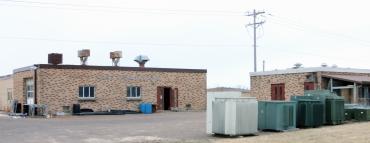
The first step in improvements to the Whitehall Wastewater Treatment Plant was approved by the city council last week. The council approved submitting a proposed plan to the Wisconsin Department of Natural Resources for the project that is expected to exceed $6.3 million. (Times photograph by Andrew Dannehy)
The Whitehall city council gave approval for engineering firm Short Elliott Hendrickson (SEH) to submit plans to improve the city’s wastewater treatment plant to the Wisconsin Department of Natural Resources.
Before last Tuesday’s regular city council meeting, a public hearing was held with Tom Madden of SEH explaining that the plant was operating above or near capacity in several areas and does not have the treatment capacity the city needs. Madden said the city appears to be eligible for money from the Wisconsin Department of Natural Resources Clean Water Fund, which could provide the city with $2.1 million that it would not have to pay back.
Madden told the council he planned a phased approach because of some unknowns with the project. The first phase of the plan will cost roughly $6.3 million.
Among the questions the city still has as it begins the project is the amount of waste that will be sent to the Whitehall station from Associated Milk Producers, Incorporated (AMPI) in Blair. Whitehall receives waste from Blair as part of a long-standing agreement between the two municipalities. Madden said between 30% and 40% of the load taken on by the Whitehall plant comes from AMPI.
“It is a big deal,” Madden said. “Unfortunately, we can’t get any information out of them on what the wastewater is going to look like in the near future.”
Madden said the city has to submit its proposal for improvements to the plant by April 30, but recommended doing so earlier.
“We have to submit a report to get funding,” Madden said. “That can’t happen by waiting around for (AMPI).”
AMPI officials told the Blair city council on March 2 that it expected its wastewater output to be about the same, but engineers were unable to confirm the exact amounts.
The other issue was a suspected leak in one of the wastewater plant’s lagoons. Madden said DNR officials had been concerned about a potential leak in the past, but the plant received a more favorable inspection grade last year. That he said created some question on if there was actually a leak, so part of the phased approach will give engineers time to investigate the matter.
If the AMPI output were to be significantly greater than expected, or if a leak in the lagoon is confirmed, Madden said it would create additional costs for the second phase of the project. He said repairing the leak would be an additional $1.5 million. The exact cost of the second phase depends on a number of factors, but would also include installing new lagoon equipment, such as covers, and installing phosphorus removal equipment.
By beginning the project now, Madden said the city can take advantage of the $2.1 million that is available from the Clean Water Fund, money he indicated would not be available in the future.
“We have to capture free money,” Madden said. “We like free money, right?”
The first phase of the project will include construction of an ultraviolet disinfection system, constructing an administration building, replacing the lift station, and testing the lagoons for leaks.
While he specified that he has not done an exact rate study, Madden estimated that much of the cost for the plant repairs would come from Blair. He provided estimates showing that Blair residents and businesses would pay a combined annual cost of $88,100 for the plant. Residential Whitehall users would pay $27,700; industrial users would pay $25,650; commercial users; $13,160; and multi-family residential users, $2,770.
Those estimates were based off current interest rates over the course of 30 years, but Madden said the city might have different financing options. He also said the cost won’t be finalized until bids for the project are received.
The council unanimously approved moving forward with the first phase, which begins by submitting the plan to the DNR.
