
Local outdoorsmen voice complaints to DNR officials
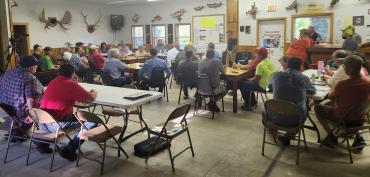
More than 50 outdoorsmen sought answers from Wisconsin Department of Natural Resources officials at the Arcadia Sportsman’s Club last Tuesday. While DNR officials from the fish hatchery division explained the decision to pause the trout-rearing co-op program, attendees didn’t appear to be satisfied and, instead, began focusing on the next step.
Local residents, many representing various conservation clubs, attended the meeting along with representatives from Trempealeau County government, state Senator Rob Stafsholt and Rep. Treig Pronschinske. Of particular interest was the DNR’s decision not to provide fish to local clubs, instead dumping them in nearby waterways and the lack of communication throughout the decision-making process.
The co-op program has been run locally since at least World War II, but the DNR announced in June that it would not continue this year. The announcement came shortly after officials inspected ponds and clubs were set to receive fingerlings to raise and later release in area streams.
DNR officials cited the costs as the reason for pausing the program but released 2,500 fish in the Waumandee Creek and Buffalo River in July.
The Waumandee Creek is located between ponds maintained by the Waumandee Rod and Gun Club and Independence Elk Rod and Gun Club (ERGC), the latter being on the Joe Bragger farm, which has raised fish since 1946.
“It was too expensive to transport them… but you brought the fish and dumped them right between our two places,” Bragger said. “Now, if the other cost was to follow up and have someone come throughout the year and check on the fish, you’re not checking on them now, so why not just put them in our ponds and work with us?”
David Giehtbrock, fish culture section leader, said the department contacted local employees to determine the best places to dump the fish. While the fish were transported to the area, Giehtbrock said it was all done in one trip — not 17 like it would take to provide the fish to the clubs.
“That saves us a considerable amount of money,” Giehtbrock said.
Attendees pointed out that clubs had offered to pay the cost to transport the fish and the employee hours to care for them, but Giehtbrock indicated he was not comfortable with such an arrangement. “I am responsible for the health of those animals,” he said.
Justine Hasz, DNR director of fisheries management/fish and wildlife parks division, explained that the department budgets in two-year cycles. It found out in January that its allotment was $2.5 million less than it had planned.
In addition to receiving less money than expected, Hasz said inflation impacted the projects “At a rate we have never seen.”
The combined factors led to immediate cuts of some programs and lengthy discussions about others, such as the trout-rearing co-op. She said the cuts made to the trout program saved the department $39,000.
“In February through April we looked at every single project we have funded in our work plan,” Hasz said. “It took some time, we have hundreds of projects, we cut more than 200 projects.”
While she said it took the department a long time to make decisions, she agreed with the complaints that the department did not do a good job communicating with local cooperators.
Hasz said 95 percent of the funds for the trout-rearing co-op program come from fishing license sales, which haven’t had a resident increase since 2005. The department and conservation clubs have requested increases on several occasions, but they have been voted down by the state legislature.
“We need for our legislature to step up and do something here,” Mike Blaha, president of the ERGC, said. “The DNR applied for an increase and it wasn’t even looked at by joint finance committee. I was told our legislature said that is a tax, I consider it a user fee… I don’t believe the sportsmen are against any increase in hunting or fishing licenses.”
Gov. Tony Evers included an increase for the DNR Fish and Wildlife account in the state budget that was passed last year, but the joint finance committee removed it. Pronschinske said he had an issue with the proposal because it only raised the cost for an archery hunting license by $3, but a firearm license by $40.
Stafsholt previously issued a call to audit the DNR accounts, saying increasing the cost for licenses would be a “non-starter” until that was done.
“I personally don’t want to ask sportsmen for more money unless I know where the money is going,” Stafsholt said.
Pronschinske previously expressed doubt that the DNR Fish and Wildlife Account was lacking funds. In July, he said DNR statements about a budget shortfall were “An inaccurate statement of facts.” He indicated he would still oppose raising resident hunting and fishing licenses.
“My position is before we raise fees on residents we need to look around our Midwest areas and states that are really really good at what they do in non-resident hunting we need to be equal or even greater and press it on them before we press it on our people,” Pronschinske said.
He said he is also waiting for the DNR’s audit, which Stafsholt said hopes to be completed by the end of the year.
“We can’t work and do a knee-jerk reaction,” Pronschinske said.
Randy Thomas, conservation congress delegate for Trempealeau County, thought an increase was past due.
“I think sportsmen have been asking for a license increase for a long time,” Thomas said. “I don’t think this is a knee-jerk reaction. It has been approved by the conservation congress.”
Stafsholt said the DNR could’ve applied for another funding mechanism to keep the program going and could still do so for next year. Hasz said doing so would limit the flexibility the department has with its accounts.
As of last week, there was still no definite answer on if or when the trout-rearing program would return. Hasz said the financial outlook going forward is worse than it was for this budget cycle.
“We have to keep this going people,” Blaha said.
Bragger said he respected Hasz and Giehtbrock for fielding questions but wanted to know the next step.
“Most of the answers, I’m just not happy with,” Bragger said. “But I have to respect two people who come in front of a group of angry people and are willing to answer questions. We’ve aired our grievances, we’re not happy with it. But we still have to work together to make this work.”
Hasz said they would take the feedback back to the DNR’s administration and said they would again ask for a budget increase. Stafsholt said a license increase is something that would be considered.
“I think we’re going to have big discussions about funding our natural resources,” Stafsholt said.
